
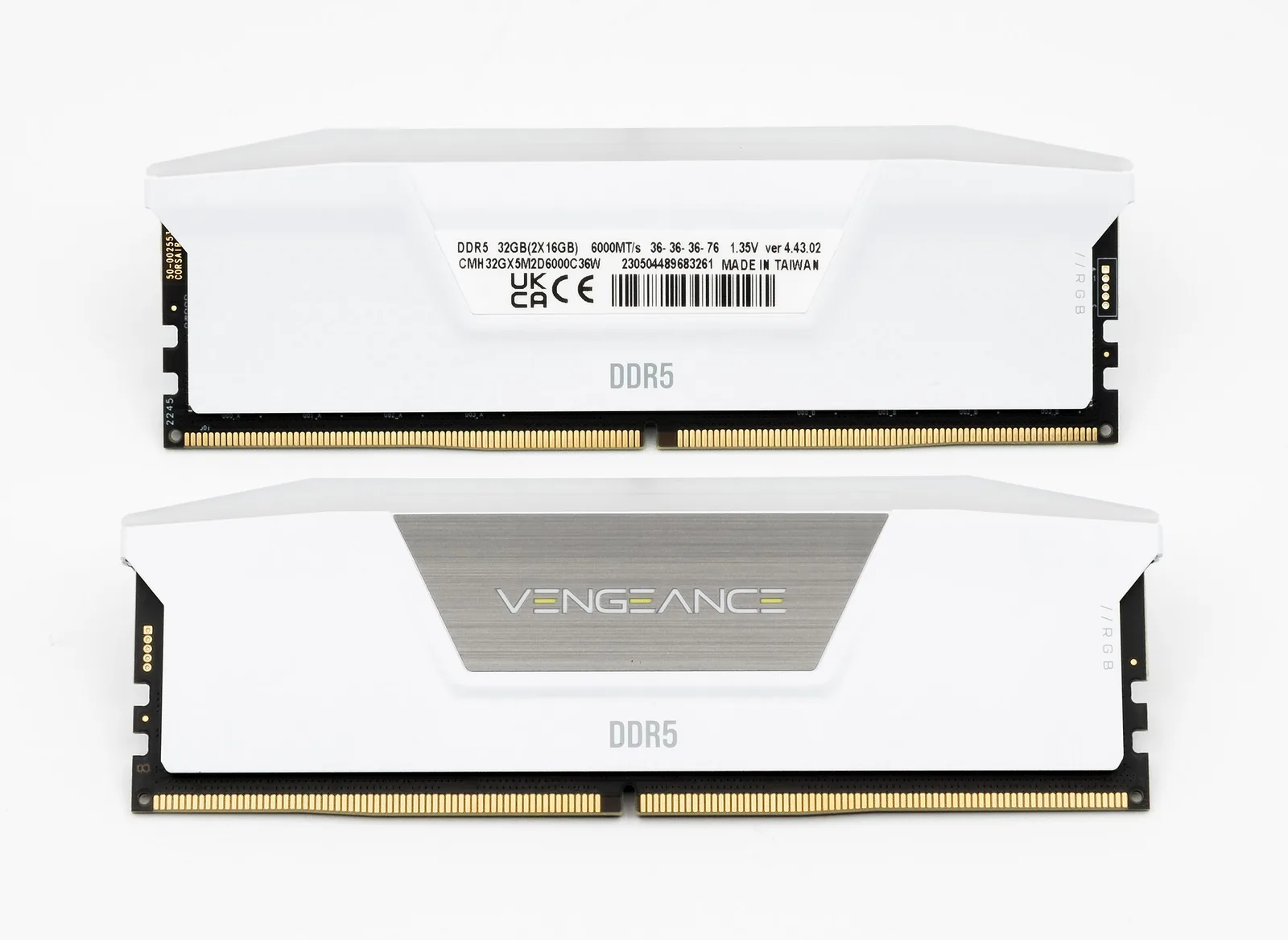
September 24, 2026, at Newegg: for a gaming PC, buy 32GB (2 x 16GB) DDR5-6000. The cheapest kit Newegg sold itself was Corsair’s Vengeance RGB CL36, wood-finish edition, at $439.99; CL30 costs $33 more (Klevv, $472.99). For VMs, big projects or local AI, Klevv’s 64GB (2 x 32GB) CL30 kit was $969.99.
Contents
By LK Wood IV · Published 2026-04-02 · Technical guidance updated 2026-10-16 · Prices checked 2026-09-24 · ~12 min read · St. Louis County, MO
The price, up front - Newegg, September 24, 2026
For a gaming PC, buy a 32GB (2 x 16GB) DDR5-6000 kit. On September 24, 2026 the cheapest one Newegg sold itself was Corsair's Vengeance RGB CL36 in its wood-finish Custom Lab edition at $439.99, $13.75 per gigabyte. CL30 costs $33 more: Klevv's CL30 kit was $472.99. For VMs, large projects or local AI, Klevv's 64GB (2 x 32GB) CL30 kit was $969.99. AMD expects elevated DDR5 pricing into roughly 2028.
Numbers move week to week; check the seller and price on the listing before buying. Full context on the crash question: the 2026 RAM and SSD price crisis.
What DDR5 costs right now (September 24, 2026)
I read these on Newegg’s product pages on September 24, 2026, between 01:13 and 01:18 CDT. Every kit below was new and in stock, and Newegg itself sold and shipped it. The price is the one in the buy box.
| Kit | Capacity | Timing | Newegg price | Per GB |
|---|---|---|---|---|
| Corsair Vengeance RGB Custom Lab (CMH32GX5M2E6000Z36WGWL) | 32GB (2 x 16GB) | CL36 | $439.99 | $13.75 |
| Patriot Viper Venom (PVV532G600C36K) | 32GB (2 x 16GB) | CL36 | $459.99 | $14.37 |
| Klevv (KD5AGU880-60A300L) | 32GB (2 x 16GB) | CL30 | $472.99 | $14.78 |
| Klevv (KD5AGUA80-60A300H) | 32GB (2 x 16GB) | CL30 | $479.99 | $15.00 |
| XPG Lancer (AX5U6000C3016G-DCLABK) | 32GB (2 x 16GB) | CL30 | $489.99 | $15.31 |
| Corsair Vengeance RGB (CMH32GX5M2E6000C36) | 32GB (2 x 16GB) | CL36 | $499.99 | $15.62 |
| Team T-Create Classic (CTCCD564G6000HC48DC01) | 64GB (2 x 32GB) | CL48 | $939.99 | $14.69 |
| Klevv (KD5BGUA80-60A300H) | 64GB (2 x 32GB) | CL30 | $969.99 | $15.16 |
| Corsair Vengeance (CMK64GX5M2D6000Z40) | 64GB (2 x 32GB) | CL40 | $989.99 | $15.47 |
| G.Skill Flare X5 (F5-6000J3636F32GX2-FX5) | 64GB (2 x 32GB) | CL36 | $1,079.99 | $16.87 |
| Kingston Fury Renegade (KF560C32RSAK2-96) | 96GB (2 x 48GB) | CL32 | $1,899.99 | $19.79 |
For prices re-checked on a different cadence, plus the buy-now-or-wait call, see the dedicated DDR5 kit price check.
Capacity is priced almost linearly up to 64GB. Klevv sells the same CL30 line at both sizes: $479.99 for 32GB (KD5AGUA80-60A300H) and $969.99 for 64GB (KD5BGUA80-60A300H), 2.02 times the price for twice the memory. The 96GB tier breaks the pattern: $19.79 per gigabyte, against $13.75 to $16.87 for every 32GB and 64GB kit above. Buy the capacity you need, then take the cheapest reliable kit at the sweet-spot speed.
Why is DDR5 so expensive right now?
If DDR5 feels like it costs several times what it did a year ago, that is exactly what happened. Memory prices began climbing in the second half of 2025, and the cause is the AI data-center buildout. Samsung, SK Hynix, and Micron - the three companies that make essentially all of the world’s DRAM - have shifted wafer capacity toward high-bandwidth memory (HBM) and high-density server DDR5, because that is where the margins are while hyperscalers buy everything they can produce.
Consumer DDR5 competes for the same fabrication lines. When a production line can make a high-margin HBM stack for an AI accelerator or a desktop kit, the desktop kit loses priority. The squeeze falls hardest on the exact 16 GB and 32 GB modules in this guide.
A 32GB DDR5-6000 kit that sold for around $80 in mid-2025 reached about $432 by early 2026 (Newegg Insider), an increase of more than 400% in under a year. On September 24, 2026 the cheapest one Newegg sold itself was $439.99.
What this means for buyers:
- Don’t wait for a crash. AMD has said publicly it expects DDR5 prices to stay high until around 2028 as new fabs ramp. There is no obvious catalyst for a sharp consumer-DDR5 drop in the near term. Buy when you need it, not on a timing bet.
- Capacity costs more than speed - the opposite of the old advice. Up to 64GB the per-gigabyte price is roughly flat, so a 64GB kit costs about twice a 32GB kit: $969.99 against $479.99 for Klevv’s CL30 kits on September 24, 2026. If 32GB covers your workload, that is $490.00 you keep.
- Used DDR5 is finally worth a look in a way it wasn’t in 2022 - the standard is mature, and a two-year-old DDR5-6000 kit performs identically to a new one, often at a meaningful discount to shortage-inflated retail.
What DDR5 means on a memory listing
DDR5 is the fifth generation of double-data-rate synchronous DRAM. Capacity and speed answer different questions: 32GB tells you how much memory the kit holds; DDR5-6000 gives its transfer rate. A 32GB kit marked 2 x 16GB contains two 16GB modules. A 64GB kit marked 2 x 32GB is not a single 64GB stick. Check that breakdown before comparing prices or filling your board’s slots.
Speed listings often say MHz when they mean MT/s, or millions of transfers per second. DDR transfers data twice per clock cycle, so DDR5-6000 has a 3,000MHz memory clock and a 6,000MT/s transfer rate. That explains a half-sized clock reading in a monitoring utility. It does not halve your kit’s advertised speed. Kingston explains the units and clock relationship.
Bandwidth measures data movement. Game performance also depends on the workload. Kingston puts DDR5’s initial 4,800MT/s rate 50% above DDR4-3200; the real application result also depends on latency and the workload. The DDR5 overview explains the design changes. The measured gaming comparisons below show why paying for a larger speed number can still be poor value.
Check the default and profile before enabling XMP or EXPO
Start with the part number. Read its datasheet. Compare its defaults with the advertised profile. Intel explains that XMP modules initially boot with JEDEC settings; supported profiles can then be selected in BIOS. That profile is an overclocking setting. Compatibility still needs checking.
Defaults vary. Kingston’s KF588CU42RWK2-48 datasheet, for example, lists a 6400 MT/s CL52 JEDEC default at 1.1 V and an 8800 MT/s CL42 XMP profile at 1.4 V. This example is a CUDIMM. Check your board’s supported module type. The sheet warns that some system configurations cannot operate at its published profile settings.
Check the motherboard’s supported-memory list. Match the kit and module count. Read its BIOS guidance too. Compare that with the CPU’s supported memory configuration. After selecting a supported profile, verify the reported rate and test stability with your actual workload. Errors need investigation. Return to supported defaults and follow the board manufacturer’s recovery instructions. Another kit’s voltage settings may not apply.
For timing comparisons, Kingston gives the CAS conversion: CL × 2000 / MT/s. At DDR5-6000, CL30 gives 10 ns and CL36 gives 12 ns for that timing component. Other timings still matter. So does the memory controller. A fixed gaming-performance gain needs workload measurements.
Match the module type to the system
Match the module type in the PC or motherboard manual. Desktop UDIMMs, laptop SODIMMs and registered server DIMMs are different products; a matching DDR5 label and capacity do not make them substitutes. For a laptop upgrade, first establish whether that exact model has replaceable memory, the required module type and its capacity limit. This desktop kit list does not establish those details for your laptop.
All DDR5 includes on-die ECC, but that corrects errors inside the memory chip. It does not protect the data path between memory and the processor. A workstation needing system-level ECC requires the appropriate ECC module and platform support; the ordinary gaming kits here should not be treated as equivalent. Kingston distinguishes on-die ECC and the available module types.
How much RAM can Windows 10 use?
Microsoft lists a 128GB physical-memory limit for 64-bit Windows 10 Home and 2TB for 64-bit Windows 10 Pro. Their 32-bit editions are limited to 4GB. Those are operating-system ceilings: the CPU, board and firmware can impose a lower limit. Check all of them before buying a high-capacity kit.
When did DDR5 come out?
DDR5 launched in late 2021 (November), alongside Intel’s 12th-generation Alder Lake CPUs. It was expensive and scarce at launch - a kit cost roughly triple its DDR4 equivalent - and matured over 2022 to 2024 into the cheap, default standard. Ironically, 2026’s AI-driven shortage has pushed prices back toward that early-adopter premium, this time for supply reasons rather than newness. By 2026, DDR5 is the only option on every current CPU platform (AMD AM5, Intel LGA 1851).
DDR4 vs DDR5 in 2026: do you even have a choice?
For anyone building a new PC in 2026, this mostly answers itself: current platforms are DDR5-only. AMD’s AM5 socket (Ryzen 7000 and 9000) and Intel’s LGA 1851 (Core Ultra) accept DDR5 exclusively. DDR4 now lives on only on older AM4 and LGA 1700 boards - the territory of budget builds and second-hand bargains.
If you are sitting on one of those boards and wondering whether to jump, memory is now the deciding cost.
| DDR4 | DDR5 | |
|---|---|---|
| Launched | 2014 | late 2021 |
| Example JEDEC defaults, not an exhaustive range | 2133-3200 MT/s | 4800/5600 MT/s; 6400 on the cited CUDIMM example |
| Common enthusiast speed | 3200-3600 MT/s | 6000-7200 MT/s |
| Voltage | 1.2 V (1.35 V XMP) | 1.1 V (1.35 V+ XMP/EXPO) |
| Channel layout per DIMM | 1 x 64-bit | 2 x 32-bit subchannels |
| On-die ECC | No | Yes (basic) |
| Power management | On motherboard | On-module PMIC |
| 2026 platforms | AM4, LGA 1700 (legacy) | AM5, LGA 1851 (current) |
Are they interchangeable? Not even slightly. DDR5 puts the keying notch in a different position than DDR4, so a DDR5 stick physically will not seat in a DDR4 slot, and vice versa. The voltage, the on-module power management, and the dual-subchannel architecture are all different. There is no adapter, and no current board takes both types in the same slots.
Should you upgrade a working DDR4 system to DDR5? Only as part of a full platform move - new CPU and motherboard, not RAM alone. On a like-for-like CPU, going from good DDR4-3600 to DDR5-6000 is a single-digit gaming uplift.
When the cheapest new 32GB kit Newegg sold itself on September 24, 2026 was $439.99, that is an especially bad trade. If you’re content on a 5800X3D or 12700K with solid DDR4, there is no RAM-only upgrade worth the money right now - put it toward a GPU instead.
The speed vs performance reality
Higher MT/s does not translate into a fixed percentage gain in applications. The studies below illustrate how results depend on the tested CPU, memory settings and workload; they are not universal limits for every current platform.
Gaming: a five-game Intel comparison
PC Gamer’s 2026 comparison tested 32GB DDR5-7200 CL34 against 32GB DDR5-6000 CL30 on Core Ultra 7 270K Plus and Core Ultra 9 285K systems, using an MSI MEG Z890 Ace and RTX 4070. Across five games at the listed 1080p settings, its reported average-FPS differences ranged from -1% to +4%. Baldur’s Gate 3 on the 270K Plus gained about 4% in averages and 8% in 1% lows.
Keep the test configuration in view. These results cover those five games. They do not establish identical frame rates for every kit between 6000 and 6400 or a universal ceiling on faster memory. Look for measurements on your CPU and games before assigning a value to the upgrade.
Productivity: a dated workstation comparison
Puget Systems’ June 2023 study compared Core i9-13900K and Ryzen 9 7950X configurations. Its weighted geometric mean scores improved by up to 4% on Intel and 7% on AMD relative to each platform’s maximum supported frequency with JEDEC timings: 5600 and 5200 MT/s respectively. The report identifies roughly 12% differences in Unreal Engine work, particularly shader compilation. Those results belong to the tested systems. Newer platforms need their own evidence.
Puget also reported that its tested AMD configuration could not complete the 6400 MT/s runs. That supports checking configuration-specific stability; it does not establish that all AMD platforms fail at that speed.
Choosing among the dated kit offers
The September 24, 2026 Newegg snapshot below compares each kit’s specifications with its price. Start with the capacity your workload needs and your platform’s supported configuration, then compare equivalent current offers. Neither this price snapshot nor the two benchmark studies establishes a universally optimal speed or guaranteed stability on both Intel and AMD systems.
| Kit | Speed / Timing | Price | Why |
|---|---|---|---|
| Corsair Vengeance RGB Custom Lab CHEAPEST | 6000 CL36 | $439.99 | Wood-finish Vengeance RGB CL36; XMP and EXPO |
| Klevv KD5AGU880-60A300L CHEAPEST CL30 | 6000 CL30 | $472.99 | $33 over the cheapest for CL30; XMP and EXPO |
| Patriot Viper Venom PVV532G600C36K | 6000 CL36 | $459.99 | EXPO profile only, so an AM5 kit |
| Klevv KD5BGUA80-60A300H 64GB PICK | 6000 CL30 | $969.99 | 2 x 32GB CL30 with XMP and EXPO |
| G.Skill Flare X5 F5-6000J3636F32GX2-FX5 64GB, AM5 | 6000 CL36 | $1,079.99 | 2 x 32GB low-profile kit with XMP and EXPO |
I may earn a commission if you buy through these affiliate links. As an Amazon Associate I earn from qualifying purchases.
Buy links for the picks above: Corsair Vengeance RGB Custom Lab 32GB CL36 (Amazon / Newegg) · Klevv 32GB CL30 (Amazon / Newegg) · Patriot Viper Venom 32GB CL36 (Amazon / Newegg) · Klevv 64GB CL30 (Amazon / Newegg) · G.Skill Flare X5 64GB CL36 (Amazon / Newegg).
The specific kit recommendations
32GB: buy the cheapest reliable DDR5-6000 rather than the fastest
In a normal market you might chase a tighter-binned kit. In the 2026 shortage I do the opposite: take any reputable 32GB DDR5-6000 kit at the lowest price from a real retailer, then put the difference toward your GPU or storage. On September 24, 2026 that was the Corsair Vengeance RGB CL36 Custom Lab edition at $439.99 at Newegg. The wood-finish heatspreaders set it apart. Its Newegg spec lists both XMP and EXPO profiles, where the black Vengeance RGB CL36 at $499.99 lists XMP only, and it costs $60.00 less.
CL36 sits outside the CL30-to-CL32 window discussed above. Its calculated CAS component at 6000 MT/s is 12 ns, against 10 ns for CL30; that alone does not establish an application-performance percentage. In the September 24 snapshot, Klevv’s CL30 kit (KD5AGU880-60A300L) at $472.99 was the cheapest CL30 kit Newegg sold itself, with both XMP and EXPO listed. Recheck the current price and your platform’s compatibility before choosing between them.
On an AM5 board the Patriot Viper Venom CL36 at $459.99 also works. Its Newegg spec lists an EXPO profile and no XMP profile. Intel owners should skip it.
Paying more for DDR5-7200 needs a workload-specific reason. The linked PC Gamer test found modest differences on its two Intel systems; it does not establish the result on your processor, games or graphics settings.
64GB: only if a real workload needs it
Going from 32GB to 64GB on AM5: add a second kit or replace? Prices are Newegg’s on September 24, 2026; speeds are what AMD lists for Ryzen 9000.
| Path | You buy | DIMMs: speed AMD lists | Old kit’s resale | What decides it |
|---|---|---|---|---|
| Keep 32GB | Nothing | 2 x 16GB: 5600 MT/s | Not sold | Whether your workload fills 32GB |
| Add an identical 2 x 16GB kit | $479.99 (Klevv KD5AGUA80-60A300H) | 4 x 16GB: 3600 MT/s | Not sold | You own this exact model; it costs $490.00 less than replacing |
| Replace, keep the old kit | $969.99 (Klevv KD5BGUA80-60A300H) | 2 x 32GB: 5600 MT/s | Kept | A second DDR5 PC to reuse the old pair |
| Replace, sell the old kit | $969.99 (Klevv KD5BGUA80-60A300H) | 2 x 32GB: 5600 MT/s | Blank: eBay sold prices not read yet | No reuse for the old pair; net resale reduces the $490.00 gap |
On a gaming build I would keep 32GB; on a workstation that needs 64GB I would replace the kit and sell or reuse the old pair, which keeps AMD’s two-DIMM rating; adding a second kit is the $490.00-cheaper route for a VM or container host that runs short of capacity rather than bandwidth. Read the price check’s When NOT to upgrade. If you are not sure 32GB is short, size the workload with the Docker RAM planner or the Proxmox capacity planner before buying either kit.
For a workstation running VMs, compiling code or editing video, 64GB earns its keep. The pick on September 24, 2026 was Klevv’s 64GB (2 x 32GB) DDR5-6000 CL30 kit at $969.99, CL30 with both XMP and EXPO, $15.16 per gigabyte. On AM5, the G.Skill Flare X5 64GB CL36 at $1,079.99 is the kit built around EXPO. The Team T-Create Classic at $939.99 runs 48-48-48-96 at 1.10V, which saves $30.00 over the Klevv and gives a 16 ns CAS component instead of 10. Judge that saving against your workload. The timing calculation alone cannot settle the purchase.
For a pure gaming build 64GB does not pay, because 32GB is the baseline and over-buying capacity is the most expensive mistake on a 2026 parts list. Buy 64GB as 2 x 32GB rather than 4 x 16GB (see the gotcha below).
96GB and up: platform-dependent, pay the premium only with a reason
96GB costs more per gigabyte. The cheapest 96GB (2 x 48GB) DDR5-6000 kit Newegg sold itself on September 24, 2026 was the Kingston Fury Renegade CL32 at $1,899.99, $19.79 per gigabyte and an XMP-only kit. The platform difference matters more than the kit difference up here: Intel’s memory controller handles 2 x 48GB DIMMs more gracefully than AMD’s at speed.
If you’re doing large-scale content creation, local AI, or heavy virtualization, 96GB exists and it works. If you’re not sure you need it, you don’t. At shortage pricing, 96GB you never touch is the most expensive empty capacity you can buy.
The gotchas nobody warns you about
XMP and EXPO are overclocks
XMP 3.0 (Intel) and EXPO (AMD) profiles are not guaranteed to work. They are overclock profiles stored in the DIMM’s SPD. Your motherboard, your specific CPU’s memory controller, and your luck in the silicon lottery all determine whether a given profile runs stable.
If a DDR5-6400 kit doesn’t post at rated speed on your board, that is not a defective kit - it is the reality of overclocking. Always check your motherboard’s QVL (Qualified Vendor List) before buying, especially for 2 x 24GB or 2 x 48GB kits, which are more finicky than 16GB and 32GB modules.
Four DIMMs: AMD rates them at DDR5-3600
AMD’s Ryzen 9000 spec pages (Ryzen 7 9800X3D and the seven others from the 9600 to the 9950X3D, read September 24, 2026) list DDR5-5600 for two DIMMs and DDR5-3600 for four, one rank or two; running above them, as EXPO at 6000 does on two DIMMs, is an overclock rather than a fault, and the 32GB-to-64GB table prices both routes.
The price spread is wild - and worse during a shortage
One Newegg listing can carry offers from several sellers at different prices, and the buy box does not always show Newegg’s own. On September 24, 2026 the Corsair Vengeance RGB 32GB CL36 was $499.99 sold by Newegg, while a marketplace store on the same listing, Flux Apex, asked $590.44.
It runs the other way too. On the G.Skill Flare X5 32GB CL36 listing, marketplace seller JB Rapid held the buy box at $506.00 and Newegg’s own offer was $539.99. Before you pay, read the “Sold by” line under the price, and check PCPartPicker or the manufacturer’s product page for legitimate retail links.
Who should buy what
Gaming builds on any budget
- Corsair Vengeance RGB Custom Lab DDR5-6000 CL36 - $439.99 at Newegg (September 24, 2026). The cheapest 32GB kit Newegg sold itself, with XMP and EXPO profiles for Intel and AMD.
- Want CL30? Klevv KD5AGU880-60A300L at $472.99, also XMP and EXPO.
Workstation / heavy multitasking (64GB)
- Klevv 64GB (2 x 32GB) DDR5-6000 CL30 - $969.99 at Newegg, and only if a real VM, compile, or editing workload needs it. On AM5, the G.Skill Flare X5 64GB CL36 at $1,079.99. Check your board's QVL for 2 x 32GB first.
Content creation / VMs / homelab workstations (96GB)
- Kingston Fury Renegade 96GB (2 x 48GB) DDR5-6000 CL32 - $1,899.99 at Newegg, an XMP-only kit. Intel handles 2 x 48GB at speed more gracefully than AMD. Buy it only with a workload that pins the RAM.
Build the system around the RAM
Choosing between two familiar brands? The Corsair Vengeance versus G.Skill Flare X5 comparison checks exact 32GB DDR5-6000 CL30 part numbers, memory profiles and cooler clearance, with a worksheet for comparing equivalent offers.
The TechFuelHQ PC Builder checks CPU socket and chipset compatibility, DDR memory type, estimated PSU headroom, motherboard fit in the case, and GPU clearance. Check the exact kit part number yourself against the motherboard maker’s QVL for your CPU and DIMM configuration, then follow the board’s BIOS instructions for XMP or EXPO. The builder does not check QVL membership or validate the kit’s rated speed. Its CC BY 4.0 parts dataset lists the components used for those checks.
For the cluster-of-cheap-nodes homelab path, the mini-PC homelab guide covers SO-DIMM kits and the RAM ceiling of each mini PC it recommends.
The verdict
Choose capacity first. Check platform compatibility next. Then compare timings against measured workload performance and current prices. Faster memory can help. The size of that benefit depends on the system and application. The September price table is historical. Recheck the offer before paying.
So buy the cheapest reliable 32GB DDR5-6000 kit - on September 24, 2026 that was the Corsair Vengeance RGB Custom Lab CL36 at $439.99 at Newegg - take exactly the capacity your workload needs and no more, then put every saved dollar toward the components that actually move the needle: your GPU and your storage.
Check the exact kit and module count against your motherboard’s support list. Buy from an authorized seller. Follow the board’s installation instructions. Enable XMP or EXPO only when the setting you want is a supported profile, then verify the operating rate and stability. A JEDEC-rated setting does not inherently require an overclocking profile. Price forecasts remain uncertain. Buy for a workload you can identify.
Sources and methodology
This guide combines vendor specifications, manufacturer QVL lists, Newegg price reads, and the published third-party benchmarks cited inline. Every current price here was read on Newegg’s product pages on September 24, 2026; historical figures are dated inline.
Primary sources cited:
- Newegg Insider: DDR5 Memory in 2026 - shortage trajectory and speed-tier context
- Club386 - AMD’s statement that DDR5 pricing may need two years to normalize
- Newegg product pages, read September 24, 2026 - every current price, seller, stock state, timing and XMP/EXPO profile above
- TechFuel HQ DDR5 price index - historical DDR5 listing captures; no price on this page comes from it
- PCPartPicker - cross-checking retail listings by manufacturer part number
- AMD Ryzen 7000/9000 QVL - official memory QVL lists
- AMD Ryzen 7 9800X3D specifications - memory speed by DIMM population, the same on the 9600, 9600X, 9700X, 9900X, 9900X3D, 9950X and 9950X3D pages, read September 24, 2026
- PC Gamer and Puget Systems - third-party gaming and productivity speed-scaling benchmarks
If you find a pricing or spec error, email contact@techfuelhq.com with the article URL and the section in question.
Frequently asked questions
How much does a 32GB DDR5 kit cost right now (September 2026)?
How much does a 64GB DDR5 kit cost in 2026?
What is the current DDR5 price per GB in 2026?
Is DDR5-6000 still the sweet spot in 2026?
How much DDR5 RAM do I need in 2026?
CL30 vs CL36 - does the timing matter?
Is XMP / EXPO required to hit advertised speeds?
Should I wait for DDR5 prices to drop before buying?
Can you mix DDR4 and DDR5 RAM?
When did DDR5 come out, and what actually changed from DDR4?
Sources and corrections
- Last updated
- Methodology
- See our methodology for research and review standards.
- Update log
10 dated updates are retained in the full log.
Read the full update log (10 entries)
- 2026-10-16 — Corrected the universal JEDEC-speed and XMP requirement, removed unsupported fixed performance percentages for CL30 versus CL36, and added a source-linked profile and compatibility check. The September 24 retailer prices are historical and were not refreshed by this technical correction.
- 2026-09-24 — I added the decision table ‘Going from 32GB to 64GB on AM5: add a second kit or replace?’ under the 64GB section. It covers four paths, each priced from the same Newegg read as the price table (Klevv KD5AGUA80-60A300H 32GB $479.99, KD5BGUA80-60A300H 64GB $969.99; all eleven listings were re-read at 02:33 CDT and none had moved), and gives the speed AMD lists for that DIMM population on its Ryzen 9000 spec pages (2x1R and 2x2R DDR5-5600, 4x1R and 4x2R DDR5-3600, read 2026-09-24 on the 9600, 9600X, 9700X, 9800X3D, 9900X, 9900X3D, 9950X and 9950X3D pages). The resale of an old kit is left blank because no eBay sold-price read exists. The four-DIMM gotcha lost its unsourced ‘400-800 MT/s below’ figure and now cites AMD in one line. The capsule, title, FAQ and prices are unchanged.
- 2026-09-24 — I replaced every price with a Newegg buy-box read of 2026-09-24, 01:13-01:18 CDT (product pages; each kit new, in stock, sold and shipped by Newegg). I removed the September 5 Best Buy, Central Computers and Google Shopping figures, and every claim that rested on the daily RAM index: its latest capture, of 2026-09-14, has publish_ready false, with 3 of 12 models against a minimum of 6. I priced the 64GB and 96GB tiers again, from Newegg. I removed the unsourced $72 ($2.25/GB) lowest-ever price and the unsourced ~$184 October 2025 point. The mid-2025 figure now reads $80, as Newegg Insider (2026-03-09) states it. The visible price band now reads $14-17/GB to match the prices on the page.
- 2026-09-12 — I rewrote the title, description and quick answer to lead with the dated September 5, 2026 prices and the $12-20/GB band, because the searches reaching this page were dated price queries. The old title still said ‘Aug 2026’. No price, quote or body figure changed, and the page’s price date (prices_valid_as_of) is unchanged.
- 2026-09-08 — Corrected the Amazon variant labels in the retailer-links row. Clean Amazon product pages B0CGR4NNPC and B0D4NLSP87 identify Lexar LD5U16G60C32LG-RUD (CL32) and Patriot PVV532G600C30K (CL30), respectively; these differ from the C38 and C36 kits in the dated price observations. The Lexar page said currently unavailable on this read. Existing price observations and destinations are unchanged. Sources:
https://www.amazon.com/dp/B0CGR4NNPCandhttps://www.amazon.com/dp/B0D4NLSP87, read September 8, 2026. - 2026-09-08 — Corrected the PC Builder description: its compatibility checks do not include motherboard QVL membership or validation of a RAM kit’s rated speed. Added the manual QVL and memory-profile checks required before choosing a kit.
- 2026-09-06 — Correction. I re-read every quote on the retailer’s own product page rather than through Google Shopping, and found two errors that shipped in the 2026-09-05 price change below. (1) The G.Skill Flare X5 was printed at $595.99 at Best Buy; Best Buy’s own page for the exact model F5-6000J3636F16GX2-FX5 prints $499.99, first-party, no marketplace seller. Shopping had reported $595.99 for that kit at three different sellers the previous day, which is the signature of a catalog or comparison figure rather than a seller price, and no single-instrument read would have caught it. The figure, its per-GB derivation ($18.62 to $15.62), the price-board bar widths, the 57% spread claim (now 32%), the kit-finder data and the calculator’s dearest-kit string all moved with it. (2) The Lexar THOR OC was labelled DDR5-6000 CL32; the kit Best Buy sells at $379.99 is C38, per its own product title. That label predates the price change and was carried through an edit that verified the number and not the spec. The recommendation now states the C38 timing and argues for it directly instead of leaving it to contradict the CL30-to-CL32 sweet spot the same page recommends. Patriot’s PVV532G600C36K showed as sold out at Newegg on 2026-09-06 at its $409.99 first-party price, with the only in-stock offer a marketplace storefront at $493.70. I re-checked the Corsair Vengeance RGB CMH32GX5M2E6000C36W at $499.99 at both Best Buy and Newegg and the Lexar THOR OC at $379.99 at Best Buy; both are correct and unchanged. What I found about the method: Google Shopping labels marketplace and reference figures as first-party retailer prices. I measured it the same night on a different pair of pages, and it did so on three of six products. A Shopping read may justify a price only after the retailer’s own page confirms the seller, and may never justify an absence.
- 2026-09-05 — I removed the Amazon-attributed prices after an audit on 2026-09-05 at 19:40 CDT. Every published price on this page was attributed to Amazon in the body: the price-board caption, the kits-table caption, the footer line and a Sources entry all named Amazon as the source of a printed figure, which the Associates operating agreement does not permit. The site’s price check exists to catch that and did not: its body test was a list of six fixed phrases and none of them matched what shipped here. I changed that test to match clause structure at the same time. The old board and kits table are replaced by a September 5, 2026 Google Shopping read (location US, marketplace sellers excluded) at named first-party retailers: Lexar THOR OC $379.99 at Best Buy, Patriot Viper Venom C36 PVV532G600C36K $409.99 at Newegg, Corsair Vengeance RGB $499.99 at Best Buy and Newegg, and G.Skill Flare X5 $595.99 at Best Buy. Beside them is this site’s own daily index row for the same day: cheapest accepted observation $489.99 at Central Computers, about $15.31/GB, six of twelve tracked kits qualified, Amazon excluded from that index by policy. Capacities above 32GB came out rather than being carried forward or scaled. Those figures were Amazon-derived and no same-day direct-retailer read exists for them, so the board, the table footnote, the kit finder and both recommendation sections now say the tier was not re-read. No first-party CL30 Patriot listing appeared on that read, so the guide names the C36 part by model instead of quoting a CL30 price it cannot back. By my decision of 2026-09-05 at 20:20 CDT, the kit-links line leads with a Newegg deeplink for each kit and keeps the existing Amazon link beside it. The title band still reads $14-20/GB and is frozen by my decision; the body states the September 5 index range of $15.31-$20.31, and the two are deliberately not synced. The slug and URL are untouched.
- 2026-08-22 — I re-fetched the cited sources on 2026-08-22 and checked the claims against them. Club386 (AMD’s David McAfee, 2026-06-08: roughly two years to a balanced market, no return to normal before 2028) and Newegg Insider ($80 mid-2025 to about $432 by early 2026) read as cited. The closing line attributed the 2028 outlook to ’the people who make the chips’; the cited statement is AMD’s, not a DRAM maker’s, so it now says AMD.
- 2026-08-21 — This guide described the daily DDR5 price index rows as “in-stock listings” and the $459.99 figure as an “in-stock floor” in four places, including the FAQ that ships as FAQPage JSON-LD. The index does not support that word. The index’s collector stamps every row availability: “not independently verified”, the 2026-08-19 capture summary lists “Direct retailer stock status is not independently confirmed.” as a blocking reason with publish_ready: false, and /data/ram-price-index/ says so in its own method note. The numbers themselves re-derive exactly from the archived 2026-08-19 capture (24 eligible offers, cheapest $459.99 at B&H, $14.375/GB) and are unchanged; only the unsupported stock claim is corrected, to “qualifying listings”. Title and slug untouched - this page is on the frozen list.
- Corrections
- Spotted an error or a stale number? Email contact@techfuelhq.com. Confirmed corrections are recorded here with the date and change.